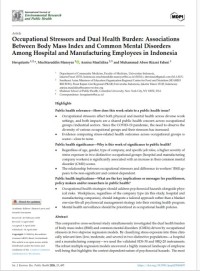
Occupational Stressors and Dual Health Burden: Associations Between Body Mass Index and Common Mental Disorders Among Hospital and Manufacturing Employees in Indonesia
Author
Muchtaruddin Mansyur - Personal NameHerqutanto - Personal Name
Annisa Maulidina - Personal Name
Muhammad Abror Rizani Fahmi - Personal Name
Abstract:
This comparative cross-sectional study simultaneously investigated the dual health burden of body mass index (BMI) and common mental disorders (CMDs) driven by occupational stressors in two stepwise regression models. By classifying stress exposure into three clinically relevant tiers (low, moderate, and severe) in two distinctive populations—a hospital and a manufacturing company—we used the validated SDS-30 and SRQ-20 instruments. The robust multiple regression models uncovered a highly nuanced landscape of employee well-being that highlights the context-dependent nature of psychosocial hazards. The most compelling findings emerged from the interaction analyses, which demonstrated that the physical and mental consequences of severe stress do not impact the workforce uniformly. Regarding mental health, severe occupational stress proved to be a potent catalyst for CMD symptoms, but this psychological toll was significantly magnified within the hospital sector relative to the manufacturing environment. An opposite, yet equally context-dependent, pattern emerged regarding physical health. In the main-effects-adjusted model, the severity of occupational stressors did not demonstrate a statistically significant linear association with an overall increase in BMI. However, the interaction model revealed a hidden vulnerability: employees in operational field roles who report severe stress are highly susceptible to severe BMI increases compared with admin personnel. While administrative staff may face sedentary risks, field workers under severe stress likely endure higher physiological allostatic load, erratic shift patterns that disrupt circadian metabolic rhythms, and potentially poorer dietary coping mechanisms during active labor. This combination of physical exhaustion and severe psychological tension severely disrupts metabolic homeostasis, forcing the redistribution of adipose tissue and driving the observed BMI spike.
Detail Information
| Series Title | : | - |
| Call Number | : | - |
| Publisher | : | Switzerland : Int. J. Environ. Res. Public Health., 2026 |
| Collation | : | Int. J. Environ. Res. Public Health 2026, 23, 495 |
| Language | : | English |
| ISBN/ISSN | : | - |
| Classification | : | NONE |
 Computer Science, Information & General Works
  Philosophy & Psychology
  Religion
  Social Sciences
  Language
  Pure Science
  Applied Sciences
  Art & Recreation
  Literature
  History & Geography