Text
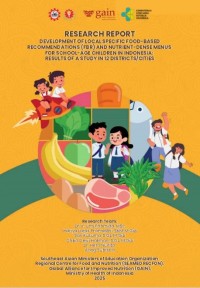
Development of Local Specific Food-Based Recommendations (FBRs) and Nutrient-Dense Menus for School-Age-Children in Indonesia: Results of a Study in 12 Districts/Cities
2025
•
SEAMEO RECFON
Author(s)
Indriya Laras Pramesthi - Personal Name
Umi Fahmida - Personal Name
Sari Kusuma - Personal Name
Aang Sutrisna - Personal Name
Hera Nurlita - Personal Name
Chika Dewi Haliman - Personal Name
Umi Fahmida - Personal Name
Sari Kusuma - Personal Name
Aang Sutrisna - Personal Name
Hera Nurlita - Personal Name
Chika Dewi Haliman - Personal Name
Synopsis / Notes
This report presents the results of a collaborative study conducted by the Southeast Asian Ministers of Education Organisation Regional Centre for Food and Nutrition (SEAMEO RECFON), the Ministry of Health of the Republic of Indonesia, and the Global Alliance for Improved Nutrition (GAIN). The study aims to develop Local Food-Based Balanced Nutrition Guidelines (PGS-PL) and nutrient-dense weekly menus tailored to the diverse dietary patterns and food availability across Indonesia’s regions to support school-based nutrition improvement initiatives.
The study involved over 4,200 school-aged children (7–18 years old) across 12 districts/cities representing six major regions: Sumatra, Kalimantan, Java, Nusa Tenggara, Sulawesi, and Maluku–Papua. Dietary intake data were collected through 24-hour dietary recalls and analyzed using Linear Programming (Optifood) to identify problem nutrients and formulate optimal dietary patterns based on locally available foods.
Findings revealed persistent gaps in key micronutrients (calcium, folate, iron, zinc, vitamin A, and vitamin C) among school-aged children and adolescents. To address these gaps, region- and age-specific PGS-PL models were developed for boys and girls across three education levels: elementary, junior high, and senior high.
Each model was translated into a seven-day menu cycle featuring three main meals and two snacks per day, designed in accordance with the national standards for the Free Nutritious Meal Program (MBG) and grounded in local food culture and availability.
The report provides an evidence-based foundation for integrating locally adapted nutrition interventions into existing government programs such as the Healthy School Movement (Gerakan Sekolah Sehat), Aksi Bergizi, and the Free Nutritious Meal (MBG) initiative. The PGS-PL framework serves as a national reference for developing sustainable, culturally appropriate, and effective school nutrition programs, contributing to the vision of a Healthy, Intelligent, and Productive Golden Generation of Indonesia 2045.
The study involved over 4,200 school-aged children (7–18 years old) across 12 districts/cities representing six major regions: Sumatra, Kalimantan, Java, Nusa Tenggara, Sulawesi, and Maluku–Papua. Dietary intake data were collected through 24-hour dietary recalls and analyzed using Linear Programming (Optifood) to identify problem nutrients and formulate optimal dietary patterns based on locally available foods.
Findings revealed persistent gaps in key micronutrients (calcium, folate, iron, zinc, vitamin A, and vitamin C) among school-aged children and adolescents. To address these gaps, region- and age-specific PGS-PL models were developed for boys and girls across three education levels: elementary, junior high, and senior high.
Each model was translated into a seven-day menu cycle featuring three main meals and two snacks per day, designed in accordance with the national standards for the Free Nutritious Meal Program (MBG) and grounded in local food culture and availability.
The report provides an evidence-based foundation for integrating locally adapted nutrition interventions into existing government programs such as the Healthy School Movement (Gerakan Sekolah Sehat), Aksi Bergizi, and the Free Nutritious Meal (MBG) initiative. The PGS-PL framework serves as a national reference for developing sustainable, culturally appropriate, and effective school nutrition programs, contributing to the vision of a Healthy, Intelligent, and Productive Golden Generation of Indonesia 2045.
File Attachment(s)
Bibliographic Information
| Call Number | - |
|---|---|
| Series Title | - |
| Publisher | Jakarta : SEAMEO RECFON., 2025 |
| Collation | 202 hal.; 22 cm |
| Language | English |
| ISBN/ISSN | 9786347702036 (pdf) |
| Classification | NONE |
 Computer Science, Information & General Works
  Philosophy & Psychology
  Religion
  Social Sciences
  Language
  Pure Science
  Applied Sciences
  Art & Recreation
  Literature
  History & Geography