Text
Health promotion and teacher performance within distance learning through the sustainability-based action teacher model
2025
•
Asian Association of Open Universities Journal
Author(s)
Muchtaruddin Mansyur - Personal Name
Nia Erlina - Personal Name
I Nengah Suparta - Personal Name
KoKomang Hendra Setiawan - Personal Name
Paken Pandiangan - Personal Name
Iwan Wicaksono - Personal Name
Nia Erlina - Personal Name
I Nengah Suparta - Personal Name
KoKomang Hendra Setiawan - Personal Name
Paken Pandiangan - Personal Name
Iwan Wicaksono - Personal Name
Synopsis / Notes
Abstract
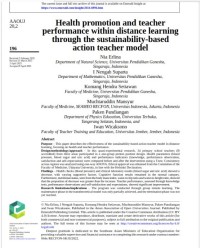
Purpose – This paper describes the effectiveness of the sustainability-based action teacher model in distance learning, focusing on health and teacher performance.
Design/methodology/approach – In this quasi-experimental research, 34 primary school teachers (B accredited) from three areas participated in a one-group pretest–posttest design. Health parameters (blood pressure, blood sugar and uric acid) and performance indicators (knowledge, performance observation, satisfaction and self-expectation) were compared before and after the intervention using a T-test. Consistency acrossregions was analyzed using one-way ANOVA. Ethical approval was obtained from the Committee of theFaculty of Medicine, Udayana University, in line with the Helsinki Declaration. Findings – Health checks (blood pressure) and clinical laboratory results (blood sugar and uric acid) showed a decrease, with varying supportive factors. Cognitive function results remained in the normal category. Furthermore, nutritionalstatus,seen fromthe bodymassindex, waist-to-hip ratio andwaist-to-heightratio,showed that the proportion of decrease was greater than the increase. Teacher performance, assessed through knowledge tests, performance observations and self-satisfaction and expectations, showed significant improvement.
Research limitations/implications – The program was conducted through group remote learning. The maintenance phase in the transtheoretical model was only partially achieved, and the termination phase was not yet reached.
File Attachment(s)
Bibliographic Information
| Call Number | - |
|---|---|
| Series Title | - |
| Publisher | : Asian Association of Open Universities Journal., 2025 |
| Collation | Asian Association of Open Universities Journal, 8 April 2025 |
| Language | English |
| ISBN/ISSN | 1858-3431 |
| Classification | NONE |
 Computer Science, Information & General Works
 Philosophy & Psychology
 Religion
 Social Sciences
 Language
 Pure Science
 Applied Sciences
 Art & Recreation
 Literature
 History & Geography