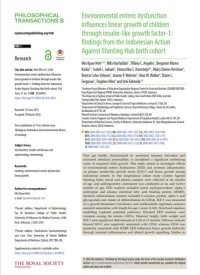
Exploring the diet–microbiome–growth axis among under-2-year-old children: a case–control study in East Lombok, Indonesia
Author
Umi Fahmida - Personal Nameaman - Personal Name
Stephen Allen - Personal Name
Elaine L. Ferguson - Personal Name
Joanne P. Webster - Personal Name
Beatriz Calvo-Urbano - Personal Name
Anouschka S. Ramsteijn - Personal Name
Isobel L. Gabain - Personal Name
Benjamin Momo Kadia - Personal Name
Tiffany C. Angelin - Personal Name
Mifa Nurfadilah - Personal Name
Hilary Davies-Kershaw - Personal Name
Min Kyaw Htet - Personal Name
Allan W. Walker - Personal Name
Abstract:
Previous studies have compared the microbiota profiles of stunted and non-stunted children. However, how these profiles interact with dietary patterns is not completely understood. To assess differences in microbial diversity, composition and bacteria taxa between stunted and non-stunted children and how the consumption of food groups influence the gut microbiota of stunted children, this matched case–control study was conducted among 150 pairs of stunted and non-stunted children of between 18–23 months old in East Lombok, Indonesia. Anthropometry and dietary data were collected by trained enumerators. Microbiome data were generated by sequencing the V4 hypervariable region of the 16S rRNA gene. No between-group differences in alpha and beta diversity were observed. Exploratory analysis identified that Agathobacter, Coprococcus, Dorea, Hominimerdicola, Lawsonibacter and Ruminococcoides were more proportionally abundant among non-stunted children and Peptostreptococcus among stunted children. However, there was no association between food group consumption and abundance of these taxa. Breastfeeding significantly shaped the microbiota profiles. Future research on the association between microbiota profiles and complementary feeding should incorporate approaches such as diet modelling to capture the combined contributions of food groups and dietary components, alongside longitudinal study designs.
Detail Information
| Series Title | : | - |
| Call Number | : | - |
| Publisher | : | London : The Royal Society Publishing., 2026 |
| Collation | : | Phil. Trans. R. Soc. B 381: |
| Language | : | English |
| ISBN/ISSN | : | - |
| Classification | : | NONE |
 Computer Science, Information & General Works
  Philosophy & Psychology
  Religion
  Social Sciences
  Language
  Pure Science
  Applied Sciences
  Art & Recreation
  Literature
  History & Geography