Text
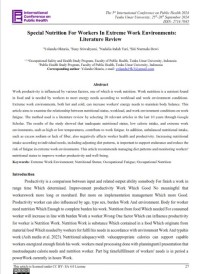
Special Nutrition For Workers In Extreme Work Environments: Literature Review
Abstract:
Work productivity is influenced by various factors, one of which is work nutrition. Work nutrition is a nutrient found in food and is needed by workers to meet energy needs according to workload and work environment conditions. Extreme work environments, both hot and cold, can increase workers' energy needs to maintain body balance. This article aims to examine the relationship between nutritional status, workload, and work environment conditions on work fatigue. The method used is a literature review by selecting 20 relevant articles in the last 10 years through Google Scholar. The results of the study showed that inadequate nutritional status, low calorie intake, and extreme work environments, such as high or low temperatures, contribute to work fatigue. In addition, unbalanced nutritional intake, such as excess sodium or lack of fiber, also negatively affects worker health and productivity. Increasing nutritional intake according to individual needs, including adjusting diet patterns, is important to support endurance and reduce the risk of fatigue in extreme work environments. This article recommends managing diet patterns and monitoring workers' nutritional status to improve worker productivity and well-being.
Availability
No copy data
Detail Information
- Series Title
-
-
- Call Number
-
-
- Publisher
- Teuku Umar University : International Conference on Public Health., 2024
- Collation
-
The 5th International Conference on Public Health 2024
- Language
-
English
- ISBN/ISSN
-
2714-7045
- Classification
-
NONE
- Content Type
-
-
- Media Type
-
-
- Carrier Type
-
-
- Edition
-
-
- Subject(s)
- Specific Detail Info
-
-
- Statement of Responsibility
-
-
Other version/related
No other version available
File Attachment
Comments
You must be logged in to post a comment
 Annual Report
  Booklet
  ECCNE
ECCNE  IPR Certificate
  Magazine
  NGTS
NGTS  NGTW
NGTW  Policy Brief
  References
  Scientific publication