Factors Associated With First Intake Among Indonesian Workers Based on the 2018 Indonesian Food Barometer (IFB) Data
Author
Rohmad Joni Pranot - Personal NameJudhiastuty Februhartanty - Personal Name
Helda Khusun - Personal Name
Dian Novita Chandra - Personal Name
Abstract:
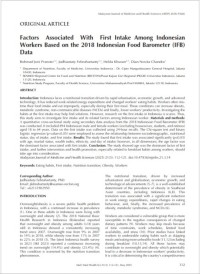
technology. It has reduced work-related energy expenditure and changed workers' eating habits. Workers often mistime their food intake and eat improperly, especially during their first meal. These conditions can increase obesity, metabolic syndrome, non-communicable diseases (NCDs) and finally, lower workers' productivity. Investigating the habits at the first intake may help find solutions. However, research on the first intake in Indonesia is scarce. Thus, this study aims to investigate first intake and its related factors among Indonesian worker.
Materials and methods:
A quantitative cross-sectional study using secondary data analysis from the 2018 Indonesian Food Barometer (IFB) was conducted. It included 894 Indonesian male and female workers (excluding housewives, students, and retirees) aged 18 to 64 years. Data on the first intake was collected using 24-hour recalls. The Chi-square test and binary ogistic regression (p-value small than 0.05) were employed to assess the relationship between sociodemographic, nutritional status, day of intake, and first intake. Results: The study found that first intake was associated significantly (p small than 0.05)
with age, marital status, wealth index, ethnicity, and day of intake; however, in all dimensions, the age factor was the dominant factor associated with first intake. Conclusion: The study showed age was the dominant factor of first intake, and further intervention and health promotion, especially related to breakfast habits among workers, should
take age into consideration.
Detail Information
| Series Title | : | - |
| Call Number | : | - |
| Publisher | : | : Mal J Med Health., 2025 |
| Collation | : | Mal J Med Health Sci 21(3): 112-121, May 2025 |
| Language | : | English |
| ISBN/ISSN | : | 2636-9346 |
| Classification | : | NONE |
 Computer Science, Information & General Works
  Philosophy & Psychology
  Religion
  Social Sciences
  Language
  Pure Science
  Applied Sciences
  Art & Recreation
  Literature
  History & Geography