Text
Realistic Food-Based Approaches Alone May Not Ensure Dietary Adequacy for Women and Young Children in South-East Asia
2019
•
Maternal and Child HealthJournal
Author(s)
Umi Fahmida - Personal Name
Emorn Wasantwisut - Personal Name
Frank Wieringa - Personal Name
Lua Tran Thi - Personal Name
Daream Sok - Personal Name
Seyha Sok - Personal Name
Bach Mai Le - Personal Name
Kuong Khov - Personal Name
Mary Chea - Personal Name
Jacques Berger - Personal Name
Louise Watson - Personal Name
Elaine L Ferguson - Personal Name
Uraiporn Chittchang - Personal Name
Nipa Rojroongwasinkul - Personal Name
Otte Santika - Personal Name
Sengchanh Kounnavong - Personal Name
Manithong Vonglokham - Personal Name
Tran Thanh Do - Personal Name
Pattanee Winichagoon - Personal Name
Synopsis / Notes
Abstract:
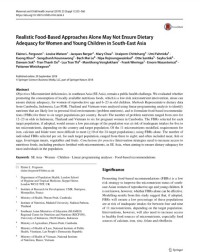
Objectives Micronutrient deficiencies, in southeast Asia (SE Asia), remain a public health challenge. We evaluated whether promoting the consumption of locally available nutritious foods, which is a low-risk micronutrient intervention, alone can ensure dietary adequacy, for women of reproductive age and 6–23 m old children. Methods Representative dietary data from Cambodia, Indonesia, Lao PDR, Thailand and Vietnam were analysed using linear programming analysis to identify nutrients that are likely low in personal food environments (problem nutrients), and to formulate food-based recommendations (FBRs) for three to six target populations per country. Results The number of problem nutrients ranged from zero for 12–23 m olds in Indonesia, Thailand and Vietnam to six for pregnant women in Cambodia. The FBRs selected for each target population, if adopted, would ensure a low percentage of the population was at risk of inadequate intakes for five to ten micronutrients, depending on the country and target population. Of the 11 micronutrients modelled, requirements for iron, calcium and folate were most difficult to meet (≥ 10 of the 24 target populations), using FBRs alone. The number of individual FBRs selected per set, for each target population, ranged from three to eight; and often included meat, fish or eggs, liver/organ meats, vegetables and fruits. Conclusions for practice Intervention strategies need to increase access to nutritious foods, including products fortified with micronutrients, in SE Asia, when aiming to ensure dietary adequacy for most individuals in the population.
Objectives Micronutrient deficiencies, in southeast Asia (SE Asia), remain a public health challenge. We evaluated whether promoting the consumption of locally available nutritious foods, which is a low-risk micronutrient intervention, alone can ensure dietary adequacy, for women of reproductive age and 6–23 m old children. Methods Representative dietary data from Cambodia, Indonesia, Lao PDR, Thailand and Vietnam were analysed using linear programming analysis to identify nutrients that are likely low in personal food environments (problem nutrients), and to formulate food-based recommendations (FBRs) for three to six target populations per country. Results The number of problem nutrients ranged from zero for 12–23 m olds in Indonesia, Thailand and Vietnam to six for pregnant women in Cambodia. The FBRs selected for each target population, if adopted, would ensure a low percentage of the population was at risk of inadequate intakes for five to ten micronutrients, depending on the country and target population. Of the 11 micronutrients modelled, requirements for iron, calcium and folate were most difficult to meet (≥ 10 of the 24 target populations), using FBRs alone. The number of individual FBRs selected per set, for each target population, ranged from three to eight; and often included meat, fish or eggs, liver/organ meats, vegetables and fruits. Conclusions for practice Intervention strategies need to increase access to nutritious foods, including products fortified with micronutrients, in SE Asia, when aiming to ensure dietary adequacy for most individuals in the population.
File Attachment(s)
Bibliographic Information
| Call Number | - |
|---|---|
| Series Title | - |
| Publisher | : Maternal and Child HealthJournal., 2019 |
| Collation | Matern Child Health J . 2019 Jan;23(Suppl 1):55-66 |
| Language | English |
| ISBN/ISSN | - |
| Classification | NONE |
 Computer Science, Information & General Works
 Philosophy & Psychology
 Religion
 Social Sciences
 Language
 Pure Science
 Applied Sciences
 Art & Recreation
 Literature
 History & Geography